Artificial Intelligence
The grok API and Video: Frames Yes, Footage No

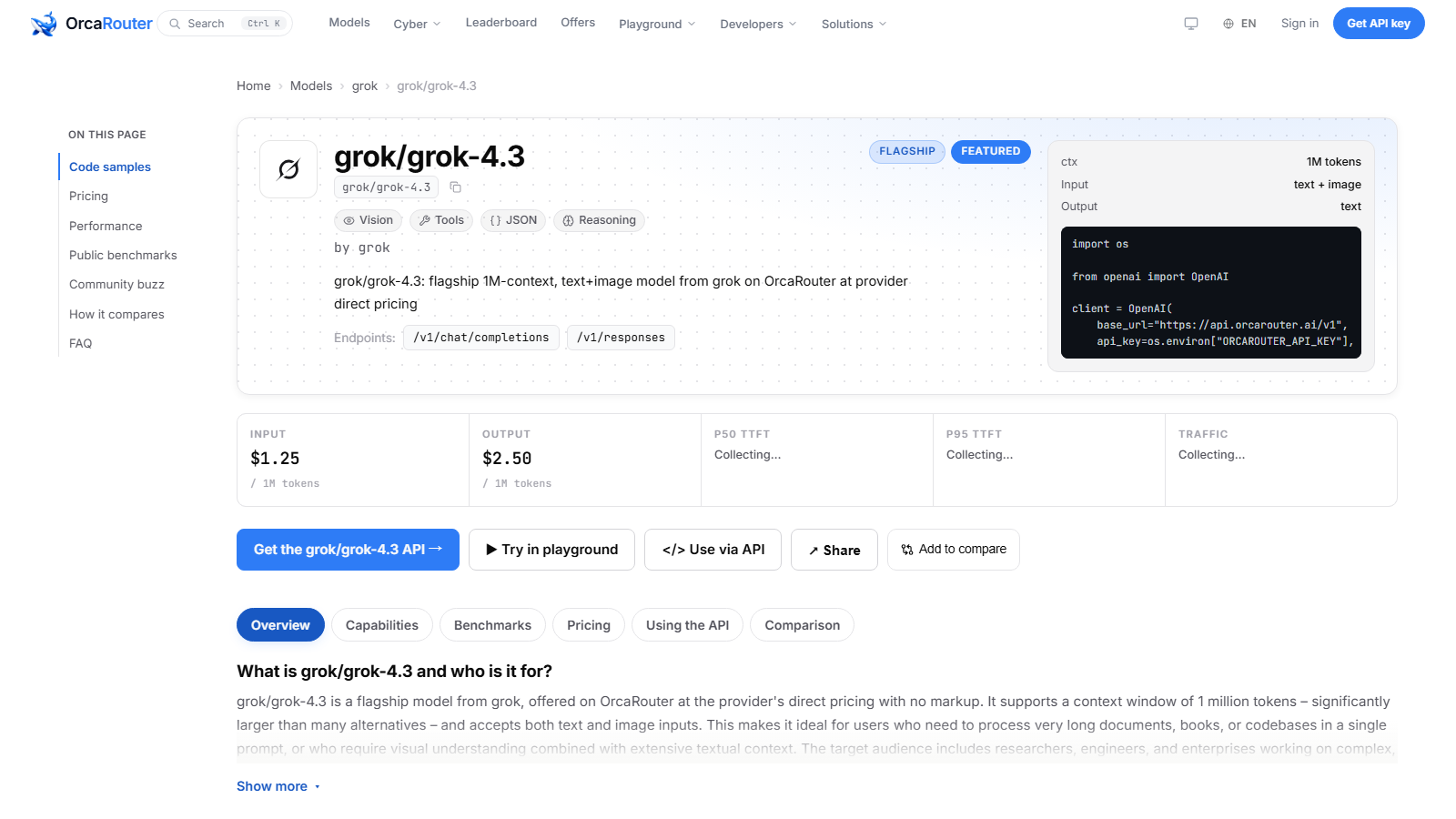
The sentence a flagship model page normally buries is printed plainly on this one. The model does not process video directly, but you can send individual frames as separate images, keeping the total within the window [VENDOR]. That is the honest headline for anyone routing video-shaped work through OrcaRouter‘s grok api catalogue: the grok flagship takes stills, not footage, and the page says so in its own words instead of letting you discover it in production.
What the model page promises about video
The capability statement lives on the model page for grok-4.3, and it is one sentence long: the model accepts text and image inputs, and “it does not process video directly, but you can send individual frames as separate images (keeping total tokens within 1M)” [VENDOR]. Everything about the workaround is bounded. Frames become images, images consume tokens, and the whole batch has to fit inside the 1,000,000-token context window [VENDOR]. So “just send frames” is really an instruction to own a preprocessing decision: frame rate, resolution and deduplication now live in the caller’s pipeline, and the budget line is the model’s window rather than the video’s duration [OURS]. On the output side the contract is equally plain — the model answers in text and never generates media [VENDOR].
What the provider page counts, and what it does not count
The provider page lists five models and a capability census: Vision 5, Tools 4, Reasoning 4, JSON mode 5 — every row in the catalogue carries the vision chip [OURS]. The census is about still images. There is no video column anywhere on the page, and no row claims one [OURS]; the only place video is discussed in the whole catalogue is the fine print on the grok-4.3 model page [VENDOR]. That is the useful lesson about reading a capability screen: a vision count tells you how many models can read a still image, and it stays silent on moving footage until a model page says otherwise [OURS].
The same table gives grok-4.3 a quality score of 10 out of 10, a composite OrcaRouter computes for its own catalogue [OURS]. And the page’s FAQ makes a point the rest of the catalogue does not: grok/grok-4.3 is $1.25 per million input tokens and $2.50 per million output tokens, and it is also the cheapest xAI model here — the flagship and the budget row are the same model [VENDOR]. The three Grok 4.x siblings sit at $2.00 per million input and $6.00 per million output with 500K windows [VENDOR], while the fifth row, grok-imagine-image, is billed at $0.200 per request — a per-request price, not free tokens [VENDOR].
Which models on the same gateway actually accept video
Against that boundary, three model pages on the same gateway say yes to footage. Qwen3.7 Flash accepts text, images and video [VENDOR]. GLM 5.3 Flash is text plus image plus video in, with text out, a 320B-total / 18B-active model priced at $0.15 per million input tokens and $0.50 per million output tokens [VENDOR]. Qwen3.8 Max accepts text, images and video at $2.00 per million input tokens and $6.00 per million output tokens [VENDOR]. The price range of the yeses matters: the video-capable rows are not all premium. If a pipeline genuinely ingests footage, the models whose pages claim video input start at a $0.03 per million input headline rate [VENDOR] and stop at $6.00 per million output [VENDOR].
The comparison is deliberately about what the catalogue states, not about which of the three is “better” — that is a separate evaluation, with numbers none of these pages volunteer in equal measure [OURS]. The point of the contrast is narrower and more useful: when your task is video understanding, there are rows whose pages commit to it and a row whose page tells you to split the clip first.
Modality claims are also worth reading narrowly. “Text, images and video in” describes what the endpoint will accept, not what the model does with it [OURS]. A page that lists video among its input modalities is making a statement about the wire format — the request will not be rejected for carrying a video part — and that is a necessary condition for a video workload rather than a sufficient one. The only way to establish the second half is to measure on your own material, which is why a catalogue is the right place to shortlist and the wrong place to decide [OURS].
There is a cheap way to settle the question for your own workload before committing to it, and it does not require reading every model page in the catalogue. Send one short clip’s worth of frames to a candidate and inspect what comes back. A model that accepts video understands temporal order and motion; a model that accepts stills answers from the frames you sent and nothing more, because the frames are all it ever received. The difference surfaces fastest in sequence questions — which of these frames came first, what changed between them — and it costs a few thousand tokens rather than an evaluation budget. The catalogue narrows the field to the rows worth testing; the test tells you whether the answer clears the bar for your task [OURS].
The other thing the grok page declines to provide
The same model page that resolves the video question declines the quality question. It states, in its own words, that specific benchmark scores for grok-4.3 are not provided in the catalog [VENDOR]. That is not a score; it is the absence of one, declared by the page itself. The contrast is visible one provider over: the model page for DeepSeek V4.1 Flash opens its benchmarks with six official release figures — 90.6 on Terminal-Bench 2.1, 90.9 on GPQA Diamond, 63.9 on HLE with tools, 65.4 on NL2Repo-Bench, 74.2 on DeepSWE v1.1, and native-vision results of 89.6 on BabyVision and 78.9 on Chartography with tools [VENDOR].
Two flagships, opposite postures: one prints its numbers, the other tells you to bring your own evals. Neither is wrong; they are different contracts about verification, and the grok contract puts the burden on the caller [OURS].
The takeaway
The takeaway is two sentences the page volunteers. If your job is video, the grok api’s flagship is a still-image model, and the official workaround is to pre-split footage into frames and manage the 1M-token budget yourself [VENDOR]. On quality, the same page supplies a boundary instead of a number, so verification is on you [VENDOR]. For footage at any price, qwen3.7-flash, glm-5.3-flash and qwen3.8-max are the rows whose pages say yes [VENDOR]; for long still-image context at $1.25 per million input and $2.50 per million output, grok-4.3 is the row [VENDOR]. Read the capability sentence before the price row. Here, the small print is the spec [OURS].
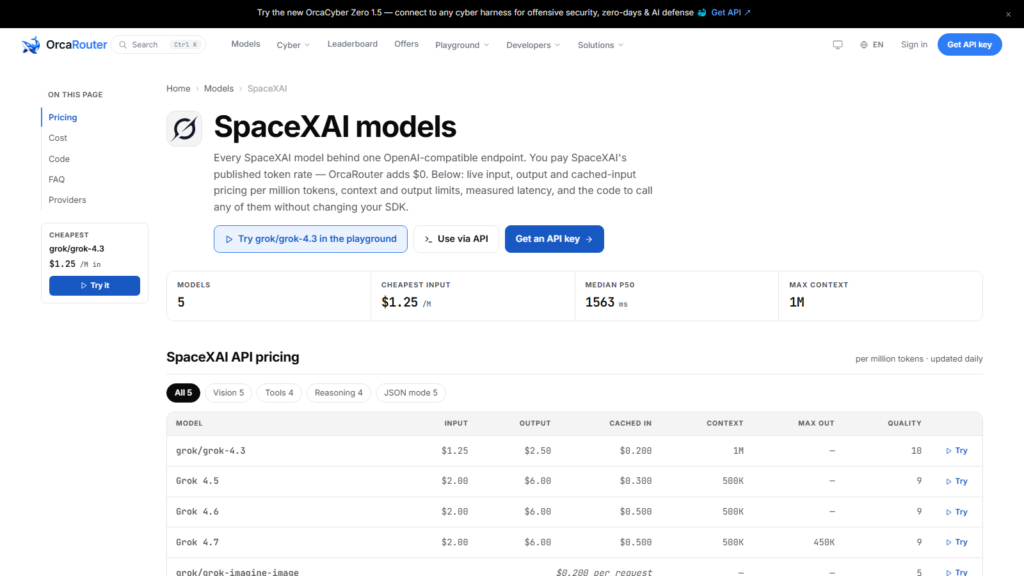
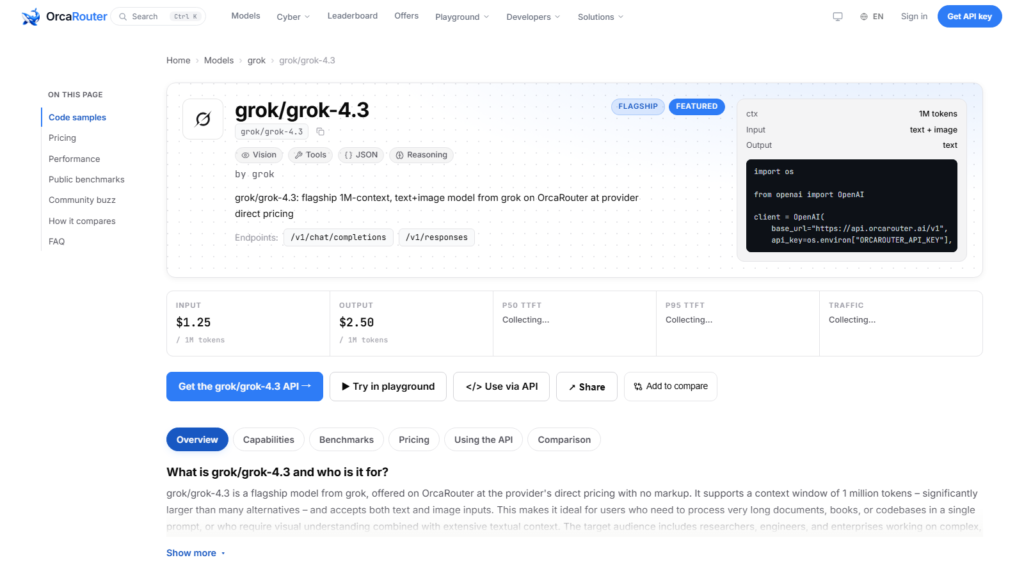
Sourcing note: the “does not process video directly” sentence, the 1M-token frame budget, the text-and-image input description, the per-request billing of grok-imagine-image, the $1.25/$2.50 rates and the statement that grok-4.3 is the cheapest xAI model, the $2.00/$6.00 Grok 4.x rates, the absence of benchmark scores for grok-4.3 and the video-accepting modality claims for Qwen3.7 Flash, GLM 5.3 Flash and Qwen3.8 Max are all read from OrcaRouter’s own grok provider and grok-4.3 model pages on 2026-10-15 [VENDOR], as is the DeepSeek V4.1 Flash release-benchmark list [VENDOR]. The capability census (Vision 5 / Tools 4 / Reasoning 4 / JSON 5), the 10/10 quality score and the reading that the census is silent on video are OrcaRouter’s own catalogue data and my interpretation of it [OURS]. The contrast between the two flagships’ benchmark postures is an observation, not a measurement. No third-party benchmark or market figures are used. Catalogue figures are rolling and will drift. Read 2026-10-15.


Who Is Rishia Haas? The Real Life Story of Andrew Zimmern’s Ex-Wife

Who Is Elaine Starchuk? The Real Life Story of Tommy Lee’s First Wife

Who Is Margie Washichek? The Real Life Story of Jimmy Buffett’s First Wife

Who Is Shelly Tresvant? The Real Life Story of Ralph Tresvant’s First Wife

Who Is Nikolai Peter Ingraham? The Real Life Story of Laura Ingraham’s Adopted Son

The grok API and Video: Frames Yes, Footage No

Who Is Thomas Emil Sicks? The Inspiring Life of Kiefer Sutherland’s Half-Brother

Who Is Aidan Thieriot? The Inspiring Life of Max Thieriot’s Brother

Who Is Michel Sáenz Castro? The Fascinating Life of Verónica Castro’s Son

Who Is Amelia Jane Henson? The Fascinating Life of Mia Sara and Brian Henson’s Daughter

Who Is América Guinart? A Remarkable Life of Alejandro Fernández’s Ex-Wife

Who Is Paris Brosnan? The Remarkable Life of Pierce Brosnan’s Son
-
 Celebrity2 months ago
Who Is Thomas Emil Sicks? The Inspiring Life of Kiefer Sutherland’s Half-Brother
-
 Celebrity2 months ago
Who Is Aidan Thieriot? The Inspiring Life of Max Thieriot’s Brother
-
 Celebrity2 months ago
Who Is Michel Sáenz Castro? The Fascinating Life of Verónica Castro’s Son
-
 Celebrity2 months ago
Who Is Amelia Jane Henson? The Fascinating Life of Mia Sara and Brian Henson’s Daughter
-
 Celebrity2 months ago
Who Is América Guinart? A Remarkable Life of Alejandro Fernández’s Ex-Wife
-
 Celebrity2 months ago
Who Is Paris Brosnan? The Remarkable Life of Pierce Brosnan’s Son
-

 Celebrity2 months ago
Who Is James Daniel Sundquist? The Extraordinary Life of Jimi Hendrix’s Son
-

 Celebrity2 months ago
Who Is London Bierk? The Real Life Story of Sebastian Bach’s Son